




Lanre Shodimu

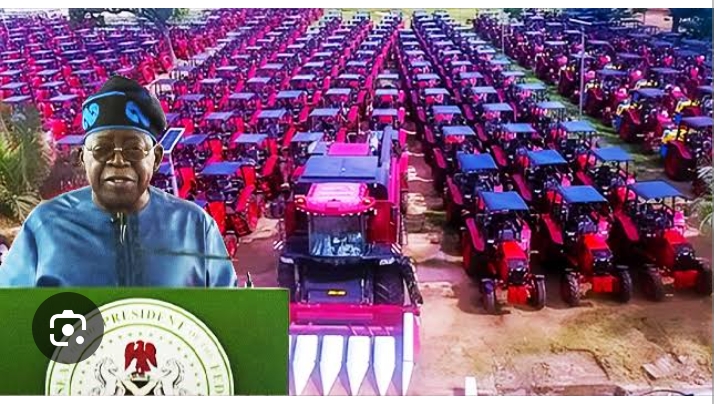
Nigeria’s commitment to agriculture growth and development as it has unveiled a large-scale agricultural mechanisation programme designed to unlock productivity, stimulate agro-industrial investment, and strengthen food security, as the Federal Government flagged off the deployment of 2,000 tractors and over 9,000 implements under the Renewed Hope National Agricultural Mechanisation Programme.
As the initiated by the Minister of Agriculture and Food Security, Senator Abubakar Kyari, says it represents one of the most capital-intensive interventions in Nigeria’s agricultural sector in recent years.
It is positioned not just as a farming support scheme, but as a structured economic stimulus targeting primary production, value chain efficiency, rural enterprise growth, and industrial manufacturing.
“This is not merely an equipment rollout,” Kyari said at the launch ceremony. “It is the ignition of a national agricultural productivity revolution.
Each tractor is expected to service approximately 600 hectares annually, translating to coverage of more than 1.5 million hectares per year when fully operational.
Government projections indicate that about 1.2 million farmers could benefit annually through shared access to mechanised services.
For investors and agribusiness operators, the significance lies in scale. Nigeria’s historically low tractor density has constrained farm expansion, delayed planting cycles, and limited yield potential.
The mechanisation programme aims to improve turnaround times, increase acreage under cultivation, and enhance productivity per hectare, critical metrics for improving domestic food supply and reducing import dependence.
Unlike previous asset-distribution schemes, the tractors are not being handed out for private ownership. Instead, they are allocated to certified Mechanisation Service Providers (MSPs) operating under a lease-to-own structure.
This service-based commercial model is designed to ensure asset utilization efficiency, financial sustainability, and broader access. Many of the MSPs are youth- and women-led enterprises, introducing an entrepreneurship dimension into the mechanisation value chain.
By positioning tractors as shared productivity assets rather than individual property, the government is effectively creating a distributed service economy around agricultural mechanisation—generating income streams not only for farmers but also for equipment operators, maintenance technicians, and rural logistics providers.
To support sustainability, the programme is backed by structured financing arrangements involving the Bank of Agriculture (BOA) in collaboration with Heifer International. The financing framework includes leasing models, hire-purchase arrangements, service aggregation, and performance-based eligibility systems.
Each tractor is expected to service approximately 600 hectares annually, translating to coverage of more than 1.5 million hectares per year when fully operational.
Government projections indicate that about 1.2 million farmers could benefit annually through shared access to mechanised services.
For investors and agribusiness operators, the significance lies in scale. Nigeria’s historically low tractor density has constrained farm expansion, delayed planting cycles, and limited yield potential.
The mechanisation is geared at improving turnaround times, increase acreage under cultivation, and enhance productivity per hectare, critical metrics for improving domestic food supply and reducing import dependence.
Market analysts say such coordination, if sustained, could reduce structural bottlenecks that have historically fragmented Nigeria’s agricultural economy.
One of the critical risks in large-scale equipment programmes is asset deterioration due to weak maintenance systems. To address this, each tractor deployed under the scheme comes with two years of free service support.
The government is also deploying 36 mobile service trucks nationwide to provide rapid technical response, while plans are underway to establish seven mega mechanization service centers across strategic zones.
From a business perspective, the Renewed Hope National Agricultural Mechanization Programme represents more than an agricultural intervention; it is an attempt to recalibrate Nigeria’s food production model toward scale, efficiency, and commercial viability.
“When history reflects on this moment, it will be to record that this administration did not manage scarcity; it engineered abundance,” Kyari said.
As tractors begin rolling into fields across the country, stakeholders will be watching closely to see whether the programme translates into measurable gains in yield, rural income, agro-industrial output, and investment confidence.