



By Simeon Shodimu

For decades, agriculture in Nigeria has remained a sector powered by relentless labour but weakened by poor structures, low returns and market inefficiencies. While millions cultivate the land and food remains visible across markets, the people at the centre of production often struggle to build lasting wealth. At the Agriwealth Revolution Summit in Lagos, stakeholders, investors and agribusiness leaders gathered to confront this contradiction, arguing that the future of Nigerian agriculture lies not merely in farming, but in building value-driven systems capable of transforming effort into sustainable prosperity.
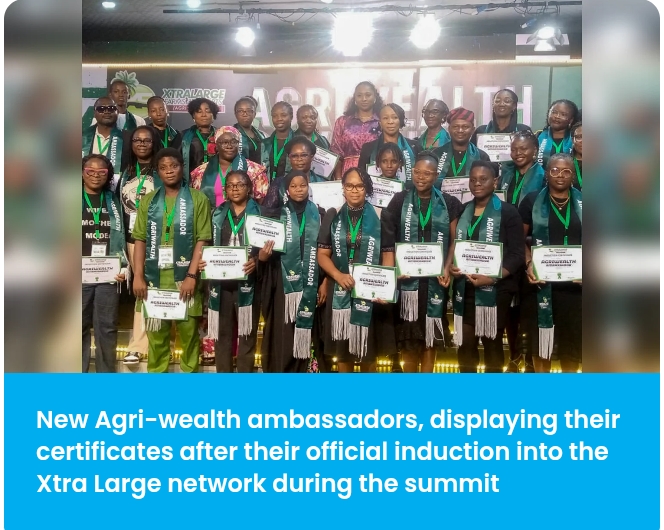
As Nigeria commemorated Workers’ Day, conversations about labour, productivity and economic survival took a different direction in Lagos, where agribusiness stakeholders challenged one of the country’s oldest assumptions — that hard work in agriculture automatically guarantees wealth.
At the Agriwealth Revolution Summit organised by XtraLarge Farms and Resorts, discussions moved beyond cultivation and harvests to a more pressing issue: why many farmers remain poor despite feeding the nation.

For participants at the summit, the answer lies not in the absence of effort, but in the structure of the agricultural system itself.
Across Nigeria, farmers continue to battle poor processing systems, weak market access, unstable pricing structures, post-harvest losses and costly logistics networks that reduce profits long before produce reaches consumers. While farmers bear the highest production risks, the largest financial gains are often captured by middlemen, distributors and informal market operators further down the value chain.
This imbalance, speakers noted, has created a system where production is rewarded with labour, but not necessarily with wealth.
Founders of XtraLarge Farms and Resorts, Dr. Seyi Davids and Dr. Moji Davids, argued that the future of agriculture depends on shifting attention from subsistence farming to value creation. According to them, agriculture should no longer be viewed simply as planting and harvesting crops, but as an interconnected economic ecosystem involving processing, branding, packaging, logistics, retail and market positioning.
Dr. Moji Davids explained that the true wealth in agriculture lies beyond the soil. Using everyday food consumption as an example, she illustrated how a single meal represents multiple layers of economic activity — from cultivation and transportation to processing, packaging and distribution — each creating opportunities for income and enterprise growth.
Drawing from her personal experience, she recounted how producing quality garri alone did not immediately translate into commercial success. Although the product met acceptable standards, it struggled within open markets until deliberate value addition through branding, repackaging and market targeting repositioned it as a premium product.
That transition, she explained, changed not only customer perception but also profitability.
“The wealth in agriculture does not only lie in the crop that you are farming, but in the value addition across the chain,” she stated.
Her observations resonated strongly with concerns raised about the huge disparity between farm gate prices and final retail costs. Participants noted that many farmers sell produce at low prices only for the same goods to reach consumers at significantly inflated costs due to multiple intermediaries, transportation challenges and informal levies embedded within the supply chain.
According to Dr. Davids, this reality explains why those directly involved in cultivation often earn the least.
“The farmers themselves don’t make the money; those who did not go to the farm are often the ones who make more money,” she remarked.
Expanding the conversation, Dr. Seyi Davids stressed the importance of repositioning agriculture as a structured business rather than a survival activity. He noted that many young people remain reluctant to enter the sector because farming is still widely associated with hardship instead of profitability.
For him, sustainable wealth in agriculture can only emerge through long-term planning, disciplined reinvestment, innovation and value addition.
“If you are not ready to add value, you are not starting agriculture,” he said.
He further described agriculture as a sector that requires patience, resilience and consistency, warning against the growing culture of seeking quick financial returns without building enduring systems.
Beyond the keynote discussions, participants at the summit shared experiences suggesting that structured agribusiness models can improve financial stability when supported by organisation, investment and access to markets.
Agribusiness leader, Amb. Paul Enakireru, spoke about moving from conventional investment channels into agriculture, describing the sector as one capable of delivering more stable returns when approached strategically. Agripreneur Damilola Osho linked her involvement to both improved food quality and financial opportunity, while farmer Tiwalewa Dada highlighted the impact of reinvesting profits across multiple agricultural ventures.
For Gov. Nkechi Ogbulogo, membership within the XtraLarge Farms and Resorts network reflected the growing importance of trust, coordination and organisational structure in sustaining participation within agribusiness.
Another major issue raised during the summit was the scale of post-harvest losses across Nigeria’s agricultural sector. According to Dr. Moji Davids, significant amounts of produce are wasted between harvest and consumption due to inadequate storage facilities, weak processing systems and poor distribution channels.
She argued that addressing these gaps would not only reduce waste but also create employment opportunities across processing, logistics, retail and packaging.
As conversations around labour and productivity continue across Nigeria, the summit reflected a growing shift in thinking — one that sees agriculture not simply as farming, but as an economic system capable of generating wealth when properly structured.
For many participants, the challenge facing Nigeria is no longer whether the country can produce food, but whether it can build systems that allow those producing the food to truly prosper from it.
Caption
From Soil to Wealth: Stakeholders at the Agriwealth Revolution Summit in Lagos advocate a shift from subsistence farming to value-driven agribusiness as the pathway to sustainable prosperity in Nigeria’s agricultural sector.