




In a bold push to accelerate food production and modernize agriculture, the Federal Government and Niger State have reaffirmed their commitment to large-scale farming through mechanization, strategic input distribution, and farmer empowerment—signaling a decisive shift from subsistence practices to agribusiness-driven growth.

By Lanre Shodimu
The Wife of the President, Oluremi Tinubu, has endorsed the agricultural transformation agenda of Niger State Governor, Mohammed Umaru Bago, describing it as a practical step toward achieving food security under the Renewed Hope Agenda of President Bola Ahmed Tinubu.
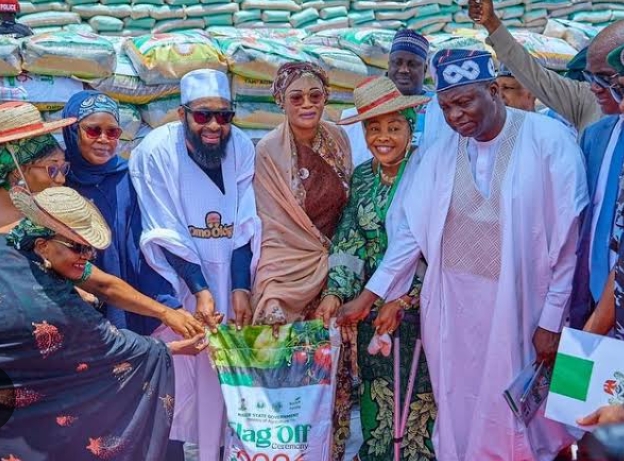
Speaking at the official flag-off of the 2026 farming season in Minna, the First Lady commended the state government’s large-scale distribution of fertilizers and farm inputs, alongside the rollout of mechanization equipment, as a strategic intervention to boost productivity and reduce reliance on manual farming.
The event, held at the Bola Ahmed Tinubu International Airport, featured the deployment of 250 tractors, 50 combine harvesters, and 150,000 bags of fertilizer to farmers across the state’s 25 local government areas.

Senator Tinubu noted that the initiative reflects a clear transition toward modern, commercially viable agriculture. According to her, empowering farmers with mechanized tools and inputs will not only improve yields but also enhance livelihoods and contribute meaningfully to Nigeria’s Gross Domestic Product (GDP).
She emphasized that Niger State has continued to distinguish itself as a major agricultural hub, demonstrating that farming remains a viable pathway to economic prosperity, job creation, and sustainable development. She also urged beneficiaries to adopt modern farming techniques, warning that traditional tools alone can no longer meet the food demands of Nigeria’s growing population.
Earlier, Governor Bago described the intervention as a comprehensive effort to revitalize farming and significantly scale up food production. He disclosed that the tractors would be distributed evenly across all local government areas to strengthen grassroots mechanization, while the combine harvesters would help curb post-harvest losses—currently estimated between 40 and 90 percent depending on crop type.
The governor added that 1,500 additional farming implements, including planters, ploughs, sprayers, and harrows, would be deployed to maximize productivity. He revealed that the initiative is expected to support cultivation across 120,000 hectares, generate about 2,000 direct jobs and up to 100,000 indirect jobs, and deliver an estimated 500,000 tonnes of food per farming season.
Also speaking, the state’s Commissioner for Agriculture, Alhaji Isah Sidi, described the initiative as a major leap toward full agricultural mechanization, noting that it would expand cultivated land and improve efficiency across the value chain.
In separate goodwill messages, the Minister of Agriculture and the Minister of Information and National Orientation praised the Niger State Government for aligning with the Federal Government’s food security agenda, describing the intervention as timely and impactful.
Caption:
Tinubu Endorses Bago’s Mechanized Farming Push as Niger Flags Off 2026 Season